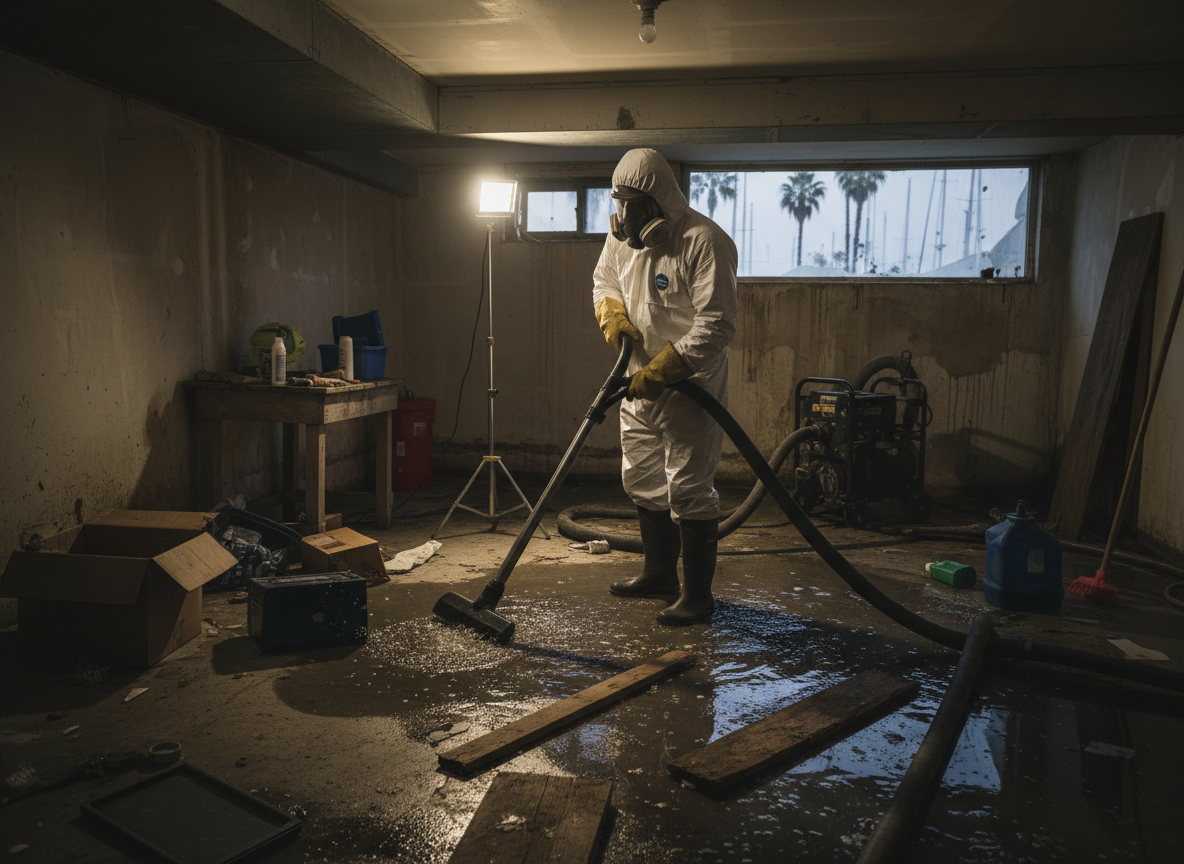
Sewage backups in Marina Del Rey often trace to aging cast-iron lines under 1960s and 1970s beach cottages in Oxford Triangle and Silver Strand. Salt air accelerates pipe corrosion while shifting sandy soils allow roots and sediment to intrude, pushing waste into crawl spaces and under slabs. Containment must account for the mild coastal Mediterranean climate that keeps humidity elevated year-round, slowing natural drying and increasing the chance of cross-contamination into neighboring units common in harbor-side condos.
Technicians isolate affected zones with physical barriers before any extraction begins, especially when properties sit close to Marina del Rey Harbor or Burton Chace Park where groundwater influence is stronger. All waste is removed to EPA-approved disposal sites in Los Angeles County; porous materials like carpet pad and drywall are discarded on-site rather than transported. Negative-air machines and antimicrobial applications follow, with extra attention to HVAC returns that can pull odors into unaffected rooms in the dense layout of Fisherman's Village townhomes.
Homeowners in Playa Vista and Culver City sometimes discover sewage has migrated across property lines because many shared laterals run under narrow streets near Venice. We document moisture readings at multiple depths and leave written clearance criteria so residents know when it is safe to reoccupy. Ignoring these steps risks long-term bacterial growth that the consistent coastal moisture never fully dries out on its own.
Technician insight
In Marina Del Rey, the thing that catches most people out with sewage cleanup is how the high water table around Mother's Beach and Burton Chace Park lets waste travel under slabs in older Silver Strand cottages, requiring excavation that inland jobs rarely need.
Sewage Backup in Silver Strand Cottage
A homeowner near Mother's Beach noticed waste surfacing after a minor storm. We traced the path to a corroded line under the slab that had allowed liquid to travel toward the neighboring property line. Extraction, disinfection, and targeted slab removal stopped further spread into the humid coastal air, and the home passed clearance testing within four days.
How it works
- 1
Initial Assessment
Technician arrives within the hour, maps the spill path, and identifies affected materials while checking for migration toward the harbor or adjacent lots.
- 2
Containment and Extraction
Physical barriers and negative pressure are set; liquid and solid waste are removed using truck-mounted equipment suited to tight beachside access.
- 3
Cleaning and Disinfection
Non-porous surfaces receive EPA-registered disinfectants; all porous items are removed and disposed following Los Angeles County guidelines.
- 4
Drying and Clearance
Dehumidifiers and air movers run until moisture readings meet industry standards; final documentation is provided before reoccupancy.
Pricing
Pricing varies with the volume of affected material, depth of migration under slabs, and accessibility constraints typical of harbor-front lots.