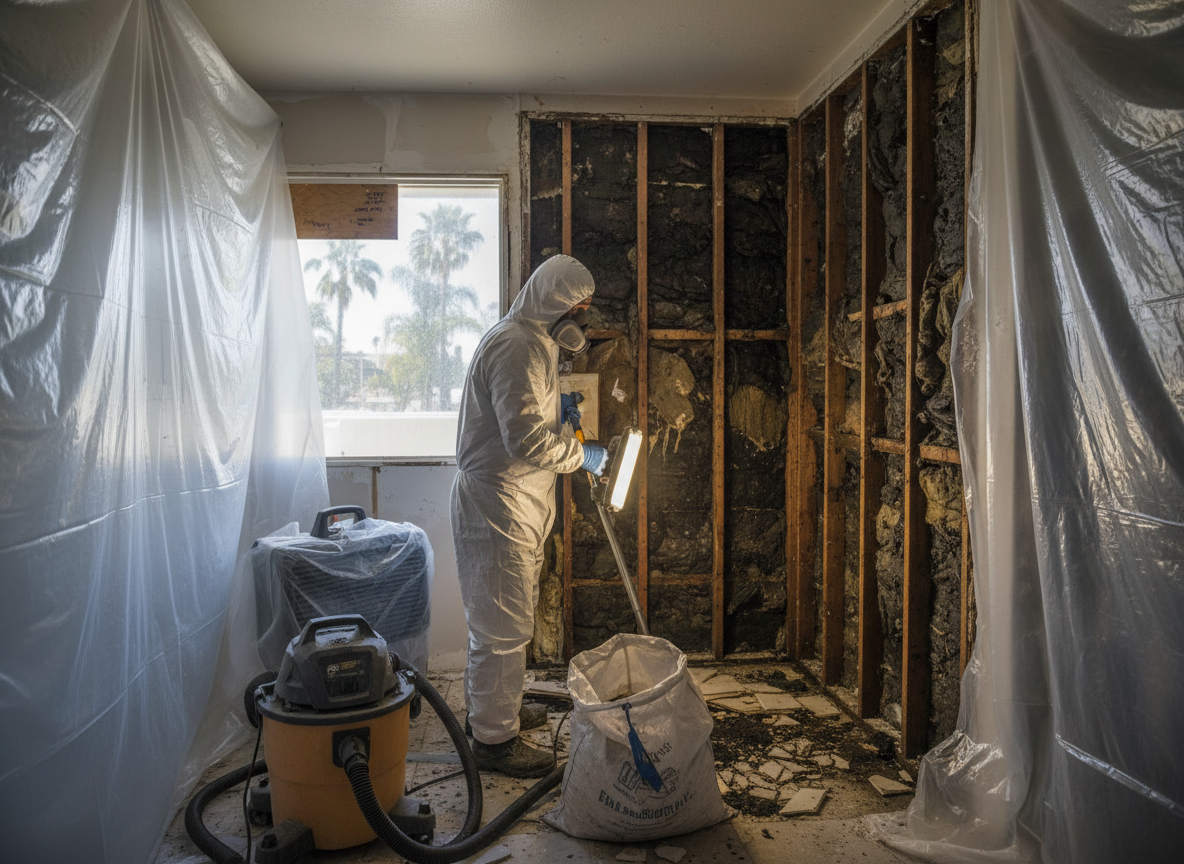
Marina Del Rey's mild Mediterranean climate keeps relative humidity elevated year-round, especially near the harbor and Mother's Beach. This persistent moisture allows mold to colonize quickly behind baseboards and in wall cavities after even small leaks from plumbing or roof penetrations common in the area's 1960s-1980s wood-frame and stucco homes. Properties in Silver Strand and Oxford Triangle often sit on fill soil that retains water, so hidden saturation in crawl spaces or slab edges frequently goes unnoticed until musty odors appear in living areas. Technicians must map moisture with infrared and pin meters before any demolition to avoid spreading spores into the salt-air environment that already stresses HVAC systems.
Los Angeles County building codes require proper containment and negative air pressure during remediation to protect adjacent units in multi-family buildings near Fisherman's Village or Burton Chace Park. Removing affected drywall and insulation must extend at least 18 inches beyond visible growth, and all porous materials in contact with Category 2 or 3 water are discarded. Post-remediation verification includes air sampling and moisture readings below 15 percent before any reconstruction begins. Homeowners in Playa Vista and Culver City frequently discover cross-contamination when shared walls or attic spaces allow spores to migrate between neighboring properties.
After extraction, drying equipment must account for the marine layer that rolls in nightly, slowing evaporation rates compared to inland Los Angeles County locations. Dehumidifiers sized for the square footage and placement of supply registers prevent re-condensation on metal ductwork common in these older homes. Final clearance testing confirms spore counts match outdoor baselines before the property is released for repairs.
Technician insight
In Marina Del Rey, the thing that catches most people out with mold remediation after water damage is how the constant marine humidity and older slab-on-grade homes near the harbor let moisture wick up into drywall even after the original leak is fixed, so you end up chasing growth two feet higher than the water line if you don't test the full wall.
Bathroom Leak Migration in Oxford Triangle
A slow shower pan leak in a 1970s triplex had allowed water to travel under the slab into the adjacent bedroom wall. Infrared scans showed elevated moisture three feet up the studs. Containment was erected, saturated drywall and insulation removed, and dehumidifiers ran for five days until readings stabilized. Air samples cleared the space for drywall replacement.
How it works
- 1
Initial Assessment
Technicians arrive within hours, document visible water sources, and use moisture meters plus thermal imaging to locate hidden saturation in walls and floors.
- 2
Containment Setup
Plastic barriers and negative air machines isolate the affected zone to prevent spore migration into unaffected rooms or neighboring units.
- 3
Removal and Cleaning
All mold-impacted porous materials are removed, surfaces are HEPA-vacuumed and treated with EPA-registered antimicrobials, and HVAC components are cleaned if contaminated.
- 4
Drying and Verification
Industrial dehumidifiers and air movers run until moisture levels stabilize, followed by independent air sampling to confirm remediation success.
Pricing
Cost depends on the square footage affected, depth of hidden moisture, and whether HVAC cleaning is required.