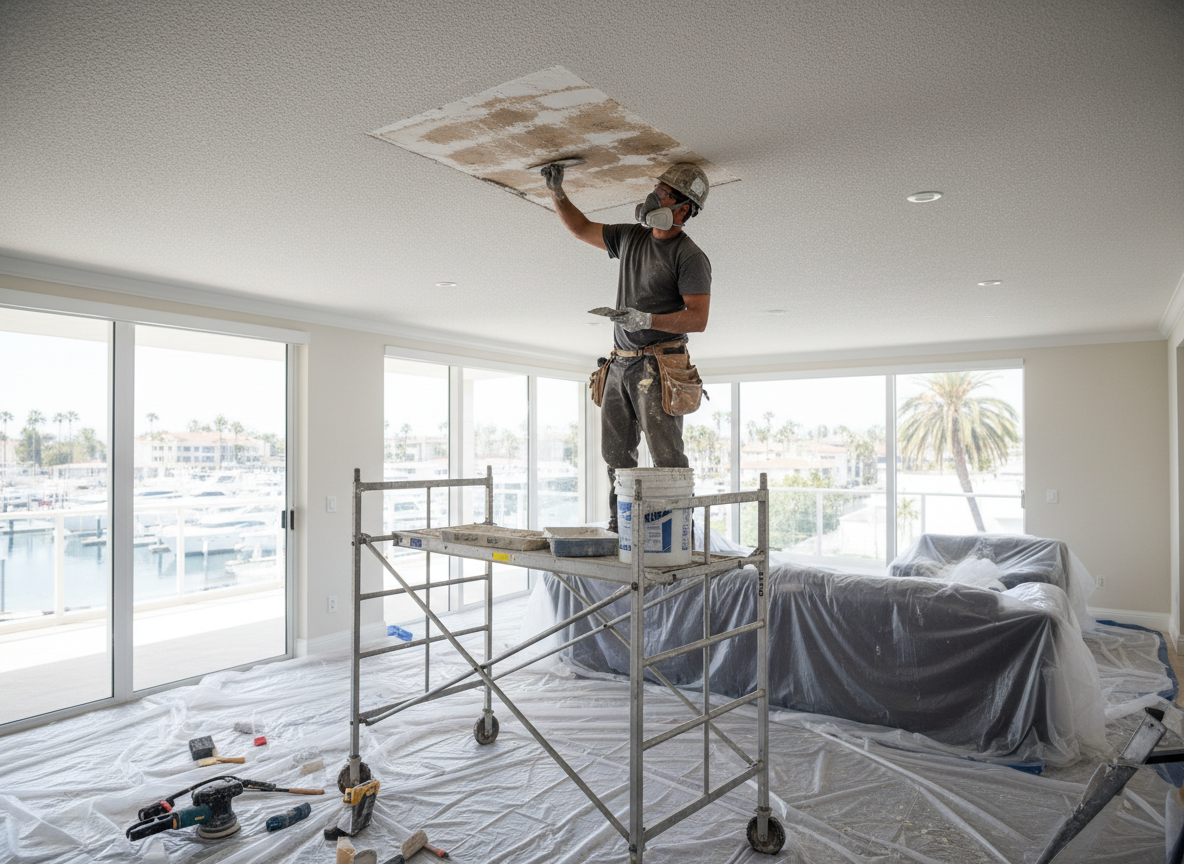
In Marina Del Rey's coastal buildings, ceiling water damage often traces to roof penetrations around HVAC units or shared plumbing stacks in 1970s-era apartments and condos near Oxford Triangle. Salt air accelerates corrosion on metal lath and drywall screws, so repairs require moisture meters to map hidden saturation beyond the visible stain. Removing only the stained section risks mold regrowth in the mild Mediterranean climate where humidity stays elevated year-round, especially in units backing onto Mother's Beach.
Access challenges appear frequently in Fisherman's Village townhomes where upper-floor leaks travel along ceiling joists into lower units. Technicians must isolate the source by pressure-testing lines rather than assuming roof failure, then install temporary containment to protect belongings below. Replacement materials must match existing fire-rated assemblies common in Los Angeles County multi-family stock to pass inspection.
Edge cases include delamination of textured ceilings popular in Silver Strand properties; scraping and retexturing the entire plane is usually required for a seamless finish. Standing water trapped above acoustic tiles can drip days later if not fully extracted, so negative air machines run during drying to pull moisture from the cavity.
Technician insight
In Marina Del Rey, the thing that catches most people out with Ceiling water damage repair is shared plumbing stacks in 1970s condos around Oxford Triangle. A leak on the third floor travels along joists and shows up two units away, so homeowners chase the wrong source until we pressure-test the lines.
Harbor-adjacent condo ceiling leak
Water appeared in a second-floor ceiling near Burton Chace Park after heavy overnight rain. We traced it to a corroded vent boot on the roof shared with the unit above. After isolating the stack and drying the joist cavity, we replaced the affected drywall section and restored the original texture without disturbing neighboring units.
How it works
- 1
Source Identification
Inspect roof, plumbing, and HVAC penetrations above the ceiling using moisture meters and thermal imaging to locate the active leak.
- 2
Containment and Extraction
Set up plastic barriers and extract standing water from the cavity to prevent further migration into walls or lower floors.
- 3
Drying and Monitoring
Place air movers and dehumidifiers, then monitor moisture levels daily until readings return to normal for the coastal climate.
- 4
Repair and Finish
Remove damaged drywall or plaster, treat for microbial growth, and reinstall matching ceiling materials with proper fire-rated sealing.
Pricing
Cost depends on square footage affected, number of floors involved, and whether access requires scaffolding near the harbor.