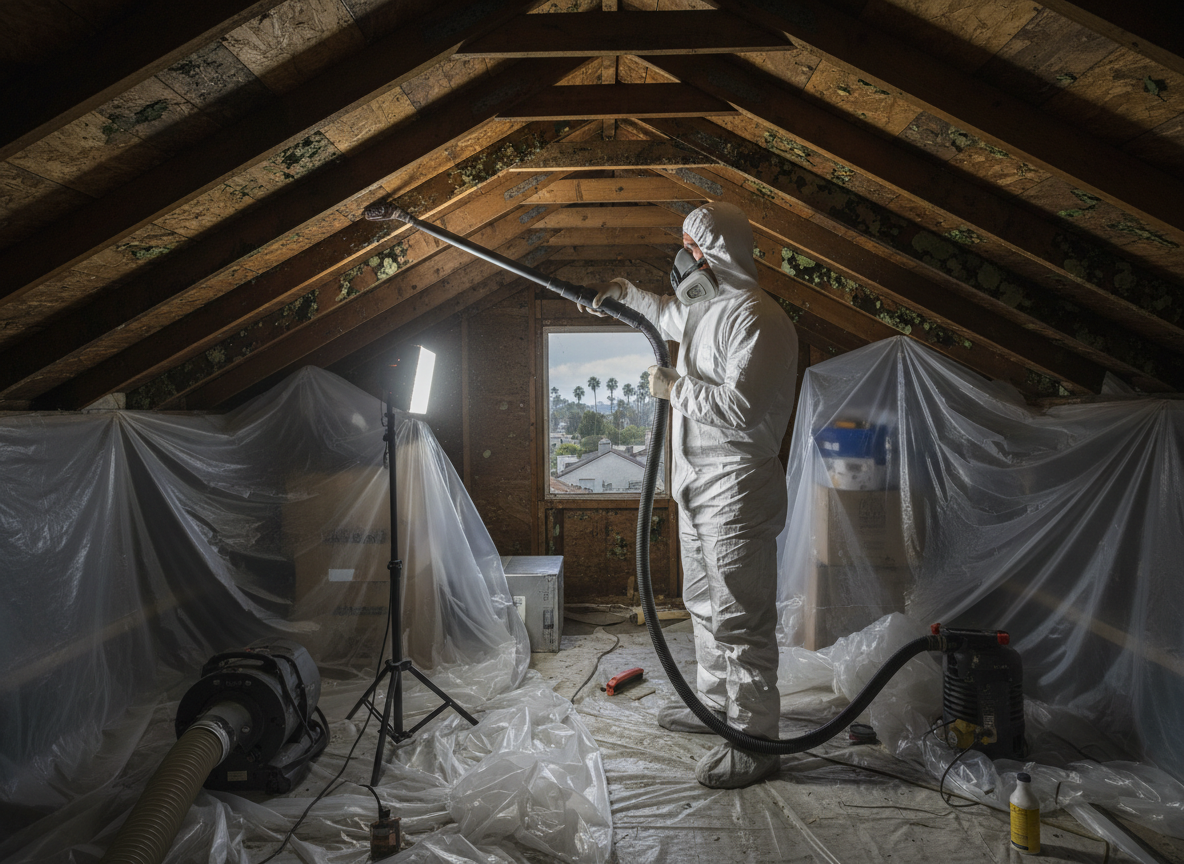
Marina Del Rey homes near the harbor and in Oxford Triangle often feature older roof assemblies with limited ridge venting that trap moisture from the mild coastal Mediterranean climate. Salt-laden air accelerates corrosion on HVAC ducts and metal trusses while persistent humidity from the Pacific allows mold to colonize insulation and sheathing even after minor roof leaks. Remediation crews must isolate the attic from living spaces using negative air machines and HEPA filtration to prevent spores from migrating into bedrooms below, especially in multi-unit buildings common along Glencoe Avenue.
Inspection begins with moisture mapping using thermal cameras to locate hidden water behind gable ends and around skylights, common failure points in Silver Strand properties exposed to winter storms. Contaminated fiberglass batts are removed in sealed bags while wood framing is treated with EPA-registered antimicrobials that account for the area's high salinity, which can reduce product efficacy. Access is frequently limited by low-pitch roofs and narrow scuttle holes typical of 1960s-1980s construction, requiring technicians to work in sections to avoid structural stress on rafters already weakened by prior water intrusion from Fisherman's Village winds.
Post-remediation verification includes air sampling at the Burton Chace Park boundary to confirm spore counts match outdoor baselines before reinstalling insulation. Homeowners in Playa Vista and Culver City often discover that bathroom exhaust fans venting directly into attics create the exact microclimate that restarts growth within months, so crews install proper termination caps and recommend continuous ridge vents suited to the local wind patterns.
Because Marina Del Rey sits at sea level, any standing water in crawlspaces or from nearby Mother's Beach flooding events can wick upward through wall cavities into attic spaces, creating edge cases where mold appears far from the original leak. Proper documentation of each step protects against Los Angeles County health department inquiries when real estate transactions occur.
Technician insight
In Marina Del Rey, the thing that catches most people out with attic mold remediation is how the constant salt air from the harbor keeps relative humidity elevated in attics even on mild days, especially in Oxford Triangle homes where original soffit vents have been painted shut during past remodels.
Harbor-Adjacent Condo Attic
A homeowner near Marina del Rey Harbor reported musty odors after winter rains. Inspection revealed mold on rafters above a bathroom vent that terminated inside the attic of a 1970s building. Crews isolated the space, removed saturated insulation, treated framing, and added proper exterior termination. Follow-up sampling confirmed levels matched outdoor baselines from nearby Venice.
How it works
- 1
Initial Assessment
Technicians arrive 24/7 from the Glencoe Avenue location, perform moisture readings, and map affected zones in attics across Marina Del Rey neighborhoods.
- 2
Containment Setup
Negative pressure zones and HEPA filtration are established to protect living areas below while accessing tight roof cavities common in Oxford Triangle homes.
- 3
Removal and Treatment
Contaminated materials are extracted and disposed; framing receives antimicrobial application formulated for coastal salt exposure.
- 4
Drying and Verification
Industrial dehumidifiers run until readings drop below 12 percent, followed by post-remediation air sampling before clearance.
Pricing
Cost depends on square footage accessed, depth of insulation removal, and any structural repairs needed after coastal moisture damage; upfront quotes provided on site.